
Friday, April 17, 2015

Monday, April 13, 2015

Sunday, April 12, 2015
How to help your Bulldog!

Bulldogs belong to a group of dogs know as "brachiocephalic" breeds or "short-nosed" breeds. Since dogs do not sweat to cool themselves as people do they rely on panting to help expel excess heat. The short nosed breeds cooling mechanism and air transfer is much less than other breeds making them very prone to over heating, heat exhaustion, and heat stroke. Temperament can also play a role in over heating. The very excitable Bulldog, or the under socialized Bulldog that gets nervous or "worked-up" is at a higher risk for breathing problems. Through excessive panting or barking Bulldogs can actually cause edema (swelling) to their throats and larynx causing severe respiratory distress. Start early with your puppy to get them used to different types of situations involving crowds, children, multiple dogs, veterinary hospitals, dog shows, etc. so they accept these as a normal part of their life. Many "old time" Bulldog breeders carry lemon juice to squirt in their dog's mouth to help clear their throats. Lemon juice is actually considered a mucolytic and is excellent at clearing mucus- so this might be worth a try if your pet has problems.
The average trachea size for an adult Bulldogs is size 7 trachea, which is based on the size of the trachea tube used in surgery. The higher number the wider the trachea is. However, it is impossible to determine exact size as many vets try and use a general (size 7 or 8) tube when in fact maybe a 9 would have fit fine. However when they use smaller ones it's usually do to a small throat. Below is size examples of trachea tubes. Thank you LIZ for the picture.
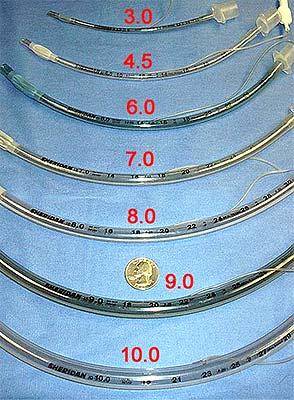
Please always use a Bulldog experienced vet. It's most important to do so, Trachea's in Bulldog are tricky, and one should be very well experienced when dealing with Bulldogs and surgery.
There is many stories of people using a non experienced vet with Bulldogs and that end up with real problems, even fatalities!
One must only exercise there Bulldog to their level of comfort. Some Bulldogs are great, they can do anything, anytime, others must limit activity. We seem to be finding better throats in Bulldogs in this day and time vs. a decade ago.
In certain individual Bulldogs the breathing problems are more pronounced and is known as "Brachiocephalic Syndrome." The first component of this is pinched nostrils (stenotic nares). The openings to the nostrils in these dogs can be no more than slits. Air sounds can frequently be heard with each breath. If you pinch your own nostrils and try to take a deep breath you will experience a feeling of negative pressure down near your larynx or voice box. This negative pressure does several things. It stretches or pulls on the soft palate which is the soft tissue just behind the hard palate (hard roof of the mouth). This condition is known as an elongated soft palate. These dogs will make excessive snorting or snoring noises. Often you can feel strong vibrations when lightly cupping your hand over the underside of their necks. Sometimes too, they will regularly spit up white frothy foam that becomes trapped in their throats. Pinched nostrils and elongated soft palates often go together and can only be helped by surgery. The nostrils can be opened with a "wedge resection" to remove tissue and create a wider opening. This can be done with very little scarring and the sooner it is performed on puppies the better. The soft palate is best shortened using a C02 laser. Lasers cause less swelling, bleeding, and pain allowing the pet to be discharged the same day. The benefits of these surgeries can be dramatic, and are greater in younger animals as compared to a dog that has been having problems for several years.

Two other components of the syndrome are everted laryngeal saccules and a hypoplastic trachea. The saccules are located down within the openings of the trachea or windpipe. The negative pressure formed higher in the airways causes a sac on either side to get sucked out into the airway with every breath. These appear almost as little balloons and further occlude the airflow. These dogs are usually the ones that have had ongoing problems left untreated. They tend to have trouble breathing with the least amount of activity or excitement. The saccules should be excised (cut out) to correct the condition. The last feature of the syndrome known as hypoplastic trachea simply means a very small trachea. Nearly all Bulldogs have a smaller diameter trachea (windpipe) than other dogs.
Saturday, April 11, 2015

Friday, April 10, 2015
BULLDOGS & THEIR CELEBRITIES! :D

ADAM SANDLER AND HIS BULLDOG, "MEATBALL".

BRAD PITT AND HIS BULLDOG, "JACQUES".

DAVID BECKHAM AND HIS BULLDOG, "COCO".

HOWARD STERN & BETH OSTROSKY WITH THEIR BULLDOG, "BIANCA".

JASON ALDEAN AND HIS BULLDOG, "ATHENS".

JESSICA BIEL AND HER BULLDOG, "EAST".

ROB DYRDEK AND HIS BULLDOGS, "BEEF" AND "MEATY".

VERNE TROYER AND HIS BULLDOG, "BANANA".

JOE JONAS AND HIS BULLDOG, "WINSTON".

JOHN LEGEND & CHRISTY TEIGEN WITH THEIR BULLDOG, "PUDDY".

MILEY CYRUS AND HER BULLDOG, "ZIGGY".

PINK AND HER BULLDOG, "ELVIS".

OLIVIA WILDE AND HER BULLDOG, "LOLA".

JODIE MARSH AND HER BULLDOG, "PADDY".

PETE WENTZ & ASHLEE SIMPSON WITH THEIR BULLDOG, "HEMINGWAY".

OZZY OSBOURNE AND HIS BULLDOG, "LOLA".

JAY BARUCHEL AND HIS BULLDOG, "PAL"

SHIA LABEOUF AND CAREY MULLIGAN WITH THEIR BULLDOG, "BRANDO".

SAMANTHA RONSON AND HER BULLDOG, "CADILLAC"
Thursday, April 9, 2015

Wednesday, April 8, 2015
The legend of the Louisiana Tech Bulldog

The legend of the Louisiana Tech Bulldog dates back to the Fall of 1899. The story involves five Tech students on their way home from class. When they reached the edge of campus, they noticed a quiet old bulldog sitting alone under a tree. Assuming the dog was a stray, they fed him all the food they had with them and continued on their way.
When the young men had reached the boarding house where they were living, one of them discovered that the bulldog had followed them. They all liked the bulldog and decided not to send him away. They received permission from the owner of the house to keep the dog and to let him sleep in the kitchen for the night. However, they would have to make other plans the next day.
During the night, a fire broke out in the house and the bulldog was the first to be awakened. The old dog became alarmed and ran from room to room tugging at the sheets of the bed to wake the students and the owner. Once the owner and the students had assembled outside, they were horrified to discover that one boy was still in the house. By this time, the house was almost completely full of smoke. Before the boys had time to react, they saw the bulldog run back into the burning house. Moments later, the final student ran out to safety. They all waited for the bulldog to come back out, but it never did.
By dawn the fire was out and the boys searched what remained of the house in hopes of finding the old bulldog alive. After a short time, they found the old dog lying in an unburned corner of the house. The smoke and heat had been too much, and the heroic dog just did not make it.
With tears in their eyes, the young men picked up the lifeless body, and without saying a word, began to walk back to the campus. When they reached the tree where they had met the bulldog only the day before, they began to dig a grave. Not wanting the bulldog to lie uncovered, two of the students took off their jackets and wrapped the bulldog. One jacket was red, the other blue.
Soon, the news of the stray old bulldog spread across the Tech campus. Everyone grieved and felt a closeness to the bulldog that most of them never knew. A loving old bulldog had become the first Tech hero.
A year after the death of the bulldog, Tech began making plans to start its first football team and needed a mascot and school colors. The students voted unanimously to become the Bulldogs in honor of Tech's first hero. The school colors were chosen to be red and blue in recognition of the colors the bulldog was buried in.
Today, no one is sure where the old bulldog is buried or of the names of the young men who saved it. However, one thing is certain. The spirit of the dog is still very much alive, and the love and loyalty it displayed has been a trademark of Tech people for many generations. Questions about the events long ago will always exist, but be assured that somewhere on the Tech campus are the remains of a brave old bulldog wrapped in red and blue.
Monday, April 6, 2015
10 Interesting Facts About Bulldogs

1. Bulldogs have a long and illustrious history and are one of the most popular dogs in the world. Because they have such an interesting story, we’ve made them our breed of the month. But how much do you know about bulldogs?
Bulldogs are the 6th most popular breed in America and French bulldogs are ranked 18th. In Los Angeles though, bulldogs are #1, and French bulldogs are #5, according to the American Kennel Club.
2. Warren G. Harding was the only U.S. President to own a bulldog while in office. His pet bulldog, Oh Boy, passed away early during his term as president, and was replaced by an Airedale terrier, Laddie Boy as First Dog.
3. Brigitte, the bulldog who plays Stella on Modern Family, has the distinction of being the first bulldog to win a Golden Collar award. She beat out dog performers from Chelsea Lately, Hot in Cleveland, Entourage, and Suburgatory. She also beat out the only human competitor, Jason Gann, the star of Wilfred.
4. Bulldogs are one of the most popular mascots for universities and sports teams. Uga, the mascot of the University of Georgia team, is one of the most famous. Sonny Seiler, famed as the attorney of Jim Williams in the book Midnight in the Garden of Good and Evil, is responsible for selecting who will fulfill Uga’s responsibilities. There have been 8 Ugas since 1956, and the search for Uga IX is currently ongoing.
5. Bulldogs were originally bred in England dating back to the 16th century, believed to be a mix of mastiffs and pugs. The English bulldog is what’s most commonly referred to as a “bulldog” but there are popular French and American varieties as well.

6. Bulldogs have suffered the most airline deaths of any breed due to their respiratory issues. They often suffer from hip dysplasia and other medical concerns.
7. Over 80 percent of bulldogs are delivered by Caesarean section. Having been bred with such large heads precludes most bulldog pups from being delivered naturally.
8. Bulldogs, like many brachycephalic (large-skulled) dogs are not well-suited for water and are in danger of drowning when swimming.
9. Many celebrities own bulldogs including Leonardo DiCaprio, Reese Witherspoon, David Beckham, Ashley Olsen, Hugh Jackman, Zac Efron, and Martha Stewart.
10. The famous haute cuisine restaurant elBulli in Catalonia, Spain run by chef Ferran Adrià is named for the French bulldogs belonging to the original owners of the land where the restaurant is located.

Wednesday, March 18, 2015
How to train your bulldog

English bulldog puppies are a bundle of joy. They are friendly, playful – in short, a great addition to your family (they're pretty much the best dogs on the face of the planet in my humble opinion!!!). ;-)
However, the arrival of your newborn canine demands some house training, and fast! Otherwise, you risk turning your home into an obstacle course of “piles and puddles”. Not fun....
House training your bulldog puppy does not have to be a stressful exercise, especially if you follow a few time-tested tactics.

Here are a few essential tips for helping your young canine (and yourself!):
A puppy’s bladder is small, and control is not part of his makeup. It is unrealistic to expect him to suppress his “release” while you are at work or otherwise occupied. Assuming that you, your wife/partner, or your kids can’t escort your puppy to a special outside area every 2-3 hours, the dog must have access to an inside location to do his thing.
Puppy owners must work as a team and demonstrate consistency, patience, and persistence if puppy house training is to be successful. Note that it may take many weeks, even months, to get it right.
English bulldog puppies can be trained at three weeks of age at the earliest. Keep in mind that potty breaks will be very frequent at the start. I didn't get to pick up my English 'Bullie' until she was 5 weeks old and I know many breeders won't let you take the puppy too early so it depends on where you get your English Bulldog.
VERY IMPORTANT: Do not punish your puppy when he “accidentally” relieves himself in the house. Similarly, always reward your dog immediately after he has completed his job in the proper location. Training is a learned activity, so your bulldog must know why he is being rewarded to associate it with positive action.
House breaking a puppy is a behavioral activity that demands rigor on the owner’s part. Dogs must be directed towards the desired end, and incentives should be triggered in their brain as motivation. Fortunately, you will have a lot of practice daily with an active puppy, so going outside should become automatic in no time!

Here are a few more ideas for your house training efforts:
Scout your puppy’s routine and “relieving” sequence. Normally, he will have to go after meals and at specific hours of the day. Watch carefully and try to catch him just before he takes off. When your bulldog starts squatting, circling or sniffing around, that’s the time to lead him to the designated area.
Use verbal cues to direct your puppy outside when he is ready to relieve himself. Ideally, one unique keyword should be used at all times in a loud, firm voice. This should distract your puppy and allow you to pick him up and carry him out before it is too late…
In the designated “release” area, use a special word (e.g. “dumper”) that triggers your puppy’s to act.
In the end, praise your bulldog with a treat or reward that signals your approval.
During puppy house training, there will be several occasions when your timing is off, and you’ll have no choice but to clean up the mess and try again next time. Remember that your bulldog is only acting naturally, so do not punish him after the fact.
Dog owners who persevere with their English bulldog puppies are quickly rewarded with obedient, well-behaved dogs. It’s a “win-win” situation for all, and you will once again be able to enjoy a relatively clean, odor-free residence.
Why do over 80 per cent of Bulldog births happen by caesarian section?
Why are so few Bulldogs born naturally?

One piece of research has particular relevance to the ongoing debate on the breeding of pedigree animals. As part of a major survey, carried out jointly by the BSAVA and the Kennel Club, data was gathered on the percentage of litters of puppies born by caesarian section compared to "natural" births. The differences between breeds was quite astonishing.
The caesarian rate in humans has been reported to be approximately 20% of all births in the UK, and around 30% of all births in the USA. The study on dogs looked at 150 breeds. There were seven breeds where the reported caesarian rate was zero ( President Obama's chosen breed, the Portuguese Water Dog was one of these). Most dog breeds had a relatively low rate of caesarians, but twelve breeds were identified as having rates greater than 40%. These included St Bernards at 41.2% and Irish Wolfhounds at 40.3%. Three breeds were singled out as having caesarian rates of over eighty per cent – the French Bulldog at 81.3%, the Bulldog at 86.1% and the Boston Terrier at a remarkable 92.3%.

Caesarian sections are carried out to save the lives of puppies and their mothers when the bitch is unable to pass the pups naturally (and perhaps sometimes pre-emptively because of a fear that she won't be able to give birth naturally). The reason for the inability to give birth is usually that the pups' heads are too big to pass through their mother's pelvic canal. This is a characteristic that is heritable. If breeders chose to breed from dogs with smaller heads (or bigger pelvises), caesarians would be much less common. A difficult birth causes significant suffering to the mother, and any surgery inevitably involves some pain. The high level of caesarians in certain breeds is something that should be addressed as an animal welfare issue.
It would be easy to reverse this trend towards caesarian sections in certain dog breeds. When puppies are registered with the Kennel Club, it could be compulsory that a note should be added to their pedigree, recording whether their birth had been natural or by caesarian section. Breeders would then be to factor this information into their choice of future breeding stock. Over a few generations, selective breeding using easy-birth dogs would be very lik ely to bring about a significant reduction in caesarian rates.
Will the Kennel Club take this type of action? I'm not holding my breath.

The History of Bulldogs
By Jon Bastian
One of today’s most popular dog breeds and human companions was originally bred for aggression. Here’s the history of bulldogs.

Bulldogs in the Beginning
Like the pit bull, bulldogs were originally bred to help butchers control livestock, although bulldogs most likely predate pit bills, with a history that can possibly be traced back to the 5th century in England and a breed called the Alaunt. By the 15th century, in addition to catching horses, cattle, and boars in legitimate (if dangerous) farming use, bulldogs were also used in the barbaric “sport” called bull-baiting, in which trained dogs would latch onto a tethered bull’s nose and not let go until the dog had pulled the bull to the ground or the bull had killed the dog. Over the course of 350 years, until bull-baiting was banned in 1835, bulldogs were bred for aggression, and an 80-pound dog could easily bring down a bull weighing close to a ton by corkscrewing its own body around its neck, tossing the bull over its own center of gravity.
After Bull Baiting—the New Bulldog Breeds
Once bull baiting was outlawed in the UK, it would seem that there would be no further need for the breed, and they probably would be extinct now were it not for their exportation to the United States and Germany. In the US, bulldogs continued to work at herding hogs and cattle, particularly in parts of the South where the terrain was too rough to allow for fences. In Germany, bulldogs were crossbred to eventually create the boxer. In England, the original working bulldog was bred to a smaller size, although there is some disagreement as to whether this was accomplished merely by selectively breeding smaller dogs, or cross-breeding with pugs. One noted bulldog breeder stated categorically, “I do not believe that a 15-pound Pug was ever crossed in the 17th or the 18th century with a 100-to-120-pound Bulldog. I do not believe that this was possible in those days, since they did not know artificial insemination.” (from a 1997 interview by David D. Jackson, MD, FACS.)
That breeder, John D. Johnson, should know his bulldogs, since he is one of two men credited with saving the breed and creating the American bulldog. Beginning as a teenager in the 1930s in rural Georgia, Johnson began selectively breeding remaining herding bulldogs, later on joining forces in the 1960s with Allen Scott of Alabama. However, the two men ultimately did not see eye to eye on what an American bulldog should be, so eventually went their separate ways, Johnson creating the larger, short-muzzled “classic” type named for him, while Scott bred the smaller, more athletic “standard” or “performance” type, which is also known as the Scott type.

Bulldogs Today—the Comeback
The bulldog—American and English—has gone on to become a popular companion and working animal, as well as a very widely used mascot, and one of the more famous corporate bulldogs is associated worldwide with Mack Trucks. In the US alone, the bulldog represents nearly four dozen universities and 250 secondary schools, and is the unofficial mascot for the US Marines. In the UK, the dog is associated with Churchill Insurance (although Winston Churchill’s dog, while often called a bulldog, was most likely a pug) and is the mascot for various football and rugby teams. Why such popularity? Perhaps because the breed shows such fierce loyalty and protectiveness toward its humans. As Johnson pointed out at the end of that interview, “They say that dog is man's best friend but they are wrong. Man is dog's best friend.” This is particularly true in the case of a breed that would no longer be around had not two men decided to do something to save it.

Subscribe to:
Posts (Atom)